Solutions
Products
Download
Purchase
Support
Support
Company
Home   Contact Us

solutions

Using Networked Serial Device Servers

Serial/IP
Solution Overview

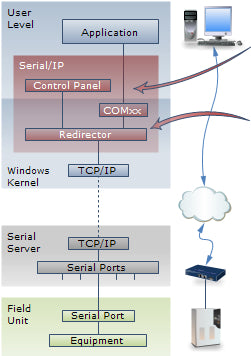
Serial servers are located near field devices and connected to their serial ports.

The serial servers are connected to a TCP/IP network. The Internet is used in the example illustrated.

The Serial/IP Redirector is installed on each application computer.

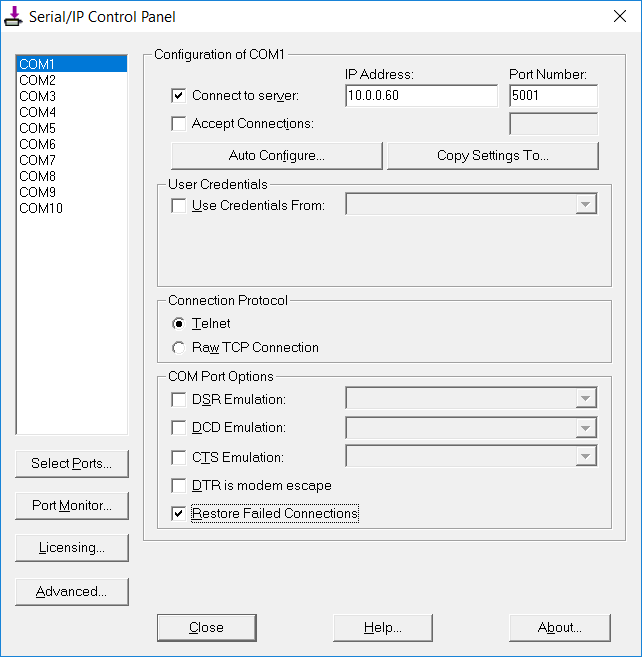
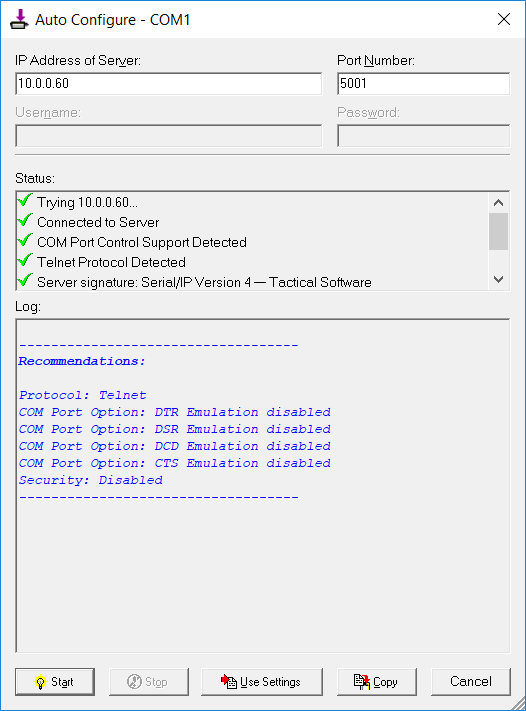
For each serial device in the field, a Serial/IP virtual COM port is created and configured with the IP address of a serial server and the unique TCP port number on that server that corresponds to the serial device.

Advantages

Devices can be located any distance from the application server.

The number of devices is not limited by the number of serial ports on the application server.

Communication is faster and less expensive than modems.

Application software is unchanged, using Serial/IP virtual COM ports instead of local hardware COM ports.


Key Design Considerations


Does your application need to control the serial servers' ports and/or get serial line signals?

If so, you may need to use serial servers that support the COM Port Control protocol (RFC 2217), which the Serial/IP Redirector uses if available. details


Are the serial servers located on an untrusted network such as the Internet?

For data security, and to allow servers to verify the indentity of connections from the network, consider using serial servers that support SSL/TLS encryption and certificate validation. Encryption is available for the Serial/IP Redirector.


Do your field devices need to initiate the connections to the serial application software?

To allow connections on-demand from the field, use serial servers that support "client mode". The Serial/IP Redirector supports such inbound connections. details


Sample Applications

Healthcare equipment — hospitals nationwide
Data analysis and presentation software on a Windows-based workstation uses Serial/IP to collect data from medical devices on a hospital's network.

Automated meter reading — major gas/electric utility companies
Data collection and reporting software on centralized servers use Serial/IP to acquire data from utility meters at substations and customer locations.

Asset Monitoring — regional electric power transmission system
Windows-based server applications use Serial/IP to reach thousands of protection relays, battery systems, and other devices through serial servers at 60 sites.

Mailing List Sign-up | Legal | Site Map
©1996–2008 Tactical Software, LLC